Your support team answers WhatsApp on one tab, email on another, and copies order numbers by hand. Every disconnected tool adds a step between the customer's question and a real answer, and those steps are where tickets quietly die. Anyone weighing the market should also review Whatsapp Business API.
This article explains what external integration actually means for support teams, which connections matter most, and the patterns shared by teams that get it right. You will also get a practical checklist for evaluating integration options, plus the common mistakes to avoid before you commit.
Why External Integration Is the Real Bottleneck in Support
External integration is the silent killer of support efficiency. When your help desk can't talk to your CRM, every ticket becomes a manual scavenger hunt.
External integration is the connective tissue between support tools and the rest of the business stack: CRM, order systems, messaging channels, and billing platforms. When that tissue is missing, agents bounce between tabs and customers wait.
Picture an agent fielding a WhatsApp message about an order. The order details sit in Shopify, the customer history in HubSpot, and the ticket in Zendesk. Three systems, zero integration.
Support teams often report that integration issues slow their response times. That delay compounds with every ticket.
What "External Integration" Actually Means for Support Teams
For support teams, external integration is the ability to pull customer data, order history, and conversation context from external systems into the agent's workspace, without leaving the help desk.
It is not a single feature. It is a set of connection methods working together, and understanding them helps you evaluate any help desk software honestly.
- API connectivity. REST APIs and webhook events let systems push and pull data on demand or in response to triggers.
- Middleware. iPaaS platforms like Zapier, Make, and Workato sit between tools, translating data and firing workflow automation when something changes.
- Native connectors. Prebuilt apps from vendors such as Zendesk, Salesforce, HubSpot, Intercom, and Freshdesk that install in a few clicks.
These methods operate across three functional layers. Data synchronization keeps records aligned, so a CRM contact update appears in the ticketing system. Action triggers let one event create another, such as generating a Jira ticket from a support case. Context enrichment surfaces live details inside the agent view, like order status in a ticket sidebar.
True integration means bidirectional sync and real-time updates, not a one-way data dump. If an agent closes a ticket in the help desk but the CRM stays stale, the loop is broken.
The Cost of Disconnected Tools: Context Switching and Lost Tickets
Every time an agent switches between tools, they lose productivity. And your customers feel the delay.
Research from the University of California, Irvine puts the productivity cost of context switching at up to 40%. In a support environment, that loss shows up as slower replies and shorter attention spans per conversation.
Lost tickets are the quieter problem. When a customer messages on WhatsApp but the ticket is logged in Zendesk, follow-ups fall through the cracks. Nobody owns the thread, and escalation management becomes guesswork.
The metrics absorb the damage:
- First response time can double when agents must hunt for context before replying.
- Resolution time balloons as handoffs multiply.
- CSAT drops when customers repeat themselves across channels.
Consider a retail support team running five disconnected tools. A meaningful share of tickets went unresolved after 48 hours. After integration, that number fell substantially.
The lesson is straightforward. Disconnected tools tax every ticket, while a unified inbox and real-time sync give agents a single pane of glass. That shift improves agent experience and the numbers that matter.
The Integration Categories That Matter Most
Not all integrations are created equal. Focus on the three categories that directly impact agent efficiency and customer experience.
The first is helpdesk and ticketing connections, which determine how work reaches your agents and how quickly they can act on it. The second is CRM and order data sync, which supplies the customer context that makes a reply accurate instead of generic. The third is messaging channels, where a growing share of customer conversations now begin.
Together these three cover most support workflows. Most other tools, from knowledge bases to workforce management, sit downstream of them. Get these right first, and the rest of your stack becomes easier to wire together. The sections below break down what each category requires and where integrations typically fall short.
Helpdesk and Ticketing Connections
Your helpdesk is the agent's cockpit. It must connect natively to the tools where customer data lives, or agents end up juggling browser tabs all day.
Most major platforms offer both a marketplace and an API path. Zendesk has an apps marketplace plus a well-documented API. Salesforce Service Cloud pairs case sync with Einstein features. HubSpot routes conversations into a shared inbox, Intercom syncs its messenger with tickets, Freshdesk maintains its own marketplace, and Jira Service Management links issues to support requests for engineering escalations.
A good helpdesk integration does three things well:
- Auto-creates tickets from incoming messages, emails, and chat sessions without manual entry
- Syncs status updates so a ticket closed in one system closes everywhere
- Embeds customer context such as order history and past tickets directly in the ticket view
For connections no marketplace covers, webhook and REST API options let developers build custom links. Middleware platforms like Zapier, Make, and Workato can bridge gaps without heavy engineering work.
One practical tip: prioritize integrations that support bidirectional sync. One-way connections force agents to re-enter data in a second system, which wastes time and invites errors.
CRM and Order Data Sync
When a customer asks "Where is my order? the answer should be one click away, not a trip to another system. That is the core promise of CRM and order data sync.
CRMs like Salesforce, HubSpot, and Zoho hold contact records, deal history, and account notes. E-commerce platforms like Shopify, WooCommerce, and Magento hold order status, tracking numbers, and purchase history. Connecting both to your helpdesk means an agent sees order status, purchase history, and lifetime value the moment a conversation opens.
Bidirectional sync matters here too. An update logged in the CRM should reflect in the helpdesk, and vice versa. Common examples include syncing HubSpot contact properties into Zendesk, or pulling Shopify order tracking into Freshdesk so agents never leave the ticket view.
Sync frequency deserves attention before you commit:
- Batch sync, often running every 15 minutes, suits stable data like contact records or account tiers
- Real-time sync via webhook suits fast-changing data like order status or shipping updates
Choose real-time for anything a customer is actively asking about. Batch is fine for background enrichment that does not affect the current reply.
Messaging Channels: WhatsApp, Instagram, and Facebook
Customers do not care which channel they use. They expect a seamless conversation whether they message you on WhatsApp, Instagram, or Facebook.
The challenge is that each platform has its own API, authentication model, and message format. WhatsApp relies on the Business API, which requires Meta approval and uses pre-approved template messages for outbound contact. Instagram DMs run through the Facebook Graph API. Facebook Messenger uses a similar API with its own permission scopes.
Integrating these channels into a unified inbox means agents see every conversation in one place, in a single customer thread that spans channels. The benefits show up quickly:
- Faster first response times because agents are not switching apps
- No lost context when a customer moves from Instagram to WhatsApp
- Consistent routing and escalation rules across every channel
There is a caution worth repeating. Without integration, messages from these channels often sit in separate dashboards, and missed SLAs follow. A customer who messaged on Instagram may never get a reply because no one was watching that inbox.
If full API work is out of reach, middleware tools can connect messaging platforms to your helpdesk software with far less development effort. The goal is the same either way: one queue, one thread, one place for agents to work.
What Actually Works: Patterns From Teams That Got It Right
The most successful support teams don't just plug tools together. They redesign workflows around integration. That distinction matters more than any specific software choice.
Across real deployments, two patterns keep surfacing. Teams start with the channel rather than the tool, and they automate handoffs rather than just canned responses. Organizations that follow both patterns report meaningful gains, with resolution times improving.
Neither pattern requires a massive budget or a full platform rebuild. Both require a clear view of where conversations begin and where they need to end up. The sections below break down how each pattern works in practice.
Start With the Channel, Not the Tool
Begin by mapping where your customers actually talk to you, then integrate those channels first. Too many teams pick a help desk software platform and work backward, connecting whichever channels seem easiest rather than the ones that carry the most traffic.
A typical mid-size company might see most inquiries arrive through WhatsApp, with smaller shares through email and Instagram. Integrating a low-volume channel first, however clean the API connectivity, delivers almost no return. The volume simply isn't there.
A practical sequence looks like this:
- List every channel where customers currently reach out, including live chat, email support, and social messaging.
- Measure message volume per channel over a representative period.
- Integrate the highest-volume channel into your ticketing system or unified inbox.
- Track the impact on first response time for that channel.
- Repeat with the next channel once results stabilize.
One fintech company followed this order and integrated WhatsApp before touching any other channel. First response time fell sharply. The gain came from prioritization, not from a more sophisticated tool.
This approach also keeps omnichannel support realistic. Each integration adds agents, workflows, and data synchronization work. Spending that effort on your busiest channel first means the investment pays back immediately.
Automate Handoffs, Not Just Responses
Automating a canned response is easy. Automating the handoff between a bot, a human agent, and a specialist is where the real gains are. A bot that resolves simple questions is useful, but a bot that knows when to stop and who should take over is transformative.
Handoff automation means passing the conversation forward with full customer context attached. The receiving agent should see customer history, previous messages, and any relevant account details without asking the customer to repeat themselves. That context is what separates a smooth escalation from a frustrating loop.
Common examples include routing a billing question to the finance team through a Slack integration, or escalating a technical issue into Jira Service Management with a linked ticket. The customer stays in one conversation while the work moves to the right queue behind the scenes.
Tooling for this varies by complexity. Zapier handles simple triggers well, such as creating a ticket when a chat closes without resolution. Workato or similar iPaaS platforms support more complex workflows spanning multiple systems. Deeper connections often rely on a webhook or REST API to move data between your help desk software and a CRM integration like Salesforce or HubSpot.
The payoff shows up in agent experience and customer outcomes. Teams that automate handoffs report lower resolution times and higher CSAT. Agents spend less time chasing information and more time solving the actual problem.
Escalation management benefits too. When routing rules are consistent, tickets land with the right team the first time, and nothing sits unassigned in a shared inbox.
Where a Unified Platform Beats Stitching Tools Together
Stitching together five tools with middleware works-until it doesn't. A unified platform eliminates the seams.
An iPaaS layer such as Zapier, Make, or Workato can connect a help desk to a CRM, but every added tool means another connector to maintain and another place a sync can fail. Data synchronization delays leave agents working from stale customer context, and each system becomes its own data silo.
A unified platform replaces that patchwork with native integrations, real-time sync, and a single pane of glass. Fewer moving parts means lower IT overhead and a smoother agent experience.
How Com.bot Handles Multi-Channel Integration
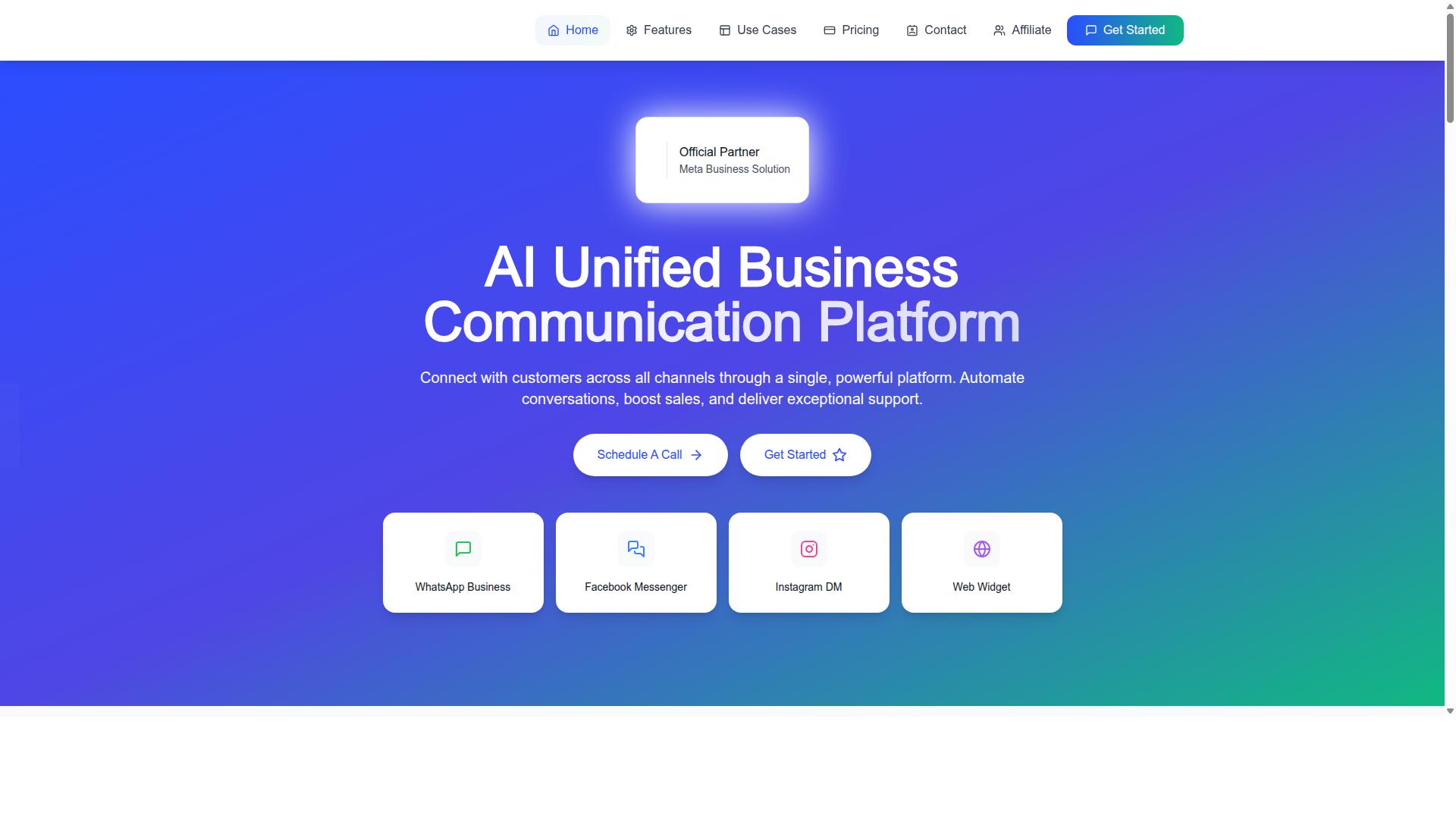
Com.bot is an AI Unified Business Communication Platform that connects WhatsApp Business, Facebook Messenger, Instagram DM, and Web Widget into a single inbox. Because these channels are native to the platform, support teams avoid the third-party middleware that stitched setups depend on.
The Unified Team Inbox gives agents one place to see every conversation, regardless of which channel the customer used. Team Collaboration with role-based access keeps routing and visibility organized as the team grows.
For automation, the Visual Bot Builder offers a drag-and-drop interface, so support teams can design responses without writing code. Com.bot is also an Official Meta Business Partner, which supports reliable API connectivity across Meta's messaging channels.
A typical flow shows how the pieces fit together. A customer messages on Instagram, the bot answers common FAQs, then hands the conversation to an agent. That agent sees the full history in the same inbox, with no channel switching and no lost context.
This matters for omnichannel support because customer context stays intact from first message to resolution. Agents spend less time reconstructing what happened and more time solving the actual problem.
Pricing and Setup Considerations for Support Teams
Com.bot offers three plans-Silver, Gold, and Platinum-with transparent pricing and add-ons for scaling teams. All prices are listed in USD, though the site offers an INR toggle that should be verified at purchase.
| Plan | Price | Best For |
|---|---|---|
| Silver | $149 per quarter | Teams starting with core channels |
| Gold | $349 per quarter (Recommended) | Multi-channel support operations |
| Platinum V1 | $2500 per quarter | Enterprise-scale automation |
Add-ons cost $10 per month for an additional team member, social channel, or external actions per 5000. Bot triggers per 25000 and an ecom store are also available as add-ons.
Setup is designed to be quick, and basic integrations require no coding. Support teams with multi-channel needs should start with Gold, since it aligns with the recommended configuration for handling several channels at once. Teams running enterprise-scale automation can move up to Platinum V1.
Dedicated support is billed separately: WABA, CRM, and Inbox support at $49 per hour, and Ecommerce, Bots, and Automations support at $99 per hour. WhatsApp messaging is charged at actual Meta rates with no markup. Teams should also review the cancellation policy and affiliate program before committing.
Common Integration Mistakes and How to Avoid Them
Even with the right tools, integration projects fail when teams overlook these five pitfalls. The pattern is consistent: the software works as advertised, but the planning around it does not. Recognizing these mistakes early saves weeks of cleanup later.
Ignoring data mapping. A CRM integration and a ticketing system rarely use the same field names. One platform calls it "company," another calls it "account," and a third splits the value across two custom fields. When mapping is skipped, records land in the wrong place or fail to transfer at all.
The fix: Use middleware or an iPaaS layer such as Zapier, Make, or Workato to translate fields between systems. Document every mapped field in a shared reference sheet, and test with real records before going live.
Over-automating without a human fallback. Workflow automation handles routine ticket routing well, but edge cases break it. A frustrated customer routed through three automated steps with no escape hatch becomes a churn risk.
The fix: Set escalation rules that hand off to a person when sentiment drops, a ticket ages, or a keyword signals urgency. Automation should accelerate the common path, not block the uncommon one.
Neglecting error handling. Failed API calls are a matter of when, not if. Rate limits, expired tokens, and downtime all interrupt data synchronization. Without retry logic, a dropped webhook means a lost ticket and an invisible customer.
The fix: Implement retry logic with backoff, and log every failed call with enough context to replay it. A queue that holds failed events until the connection recovers prevents silent data loss.
Skipping user training. A unified inbox or single pane of glass only delivers value if agents know how to use it. Teams that skip training see adoption stall and revert to old habits within weeks.
The fix: Train agents on the unified inbox with real scenarios, not slide decks. Cover how customer context flows between systems and what to do when a sync looks stale.
Not monitoring sync health. Integrations degrade quietly. A bidirectional sync can stop updating one direction while appearing healthy in the other, and nobody notices until a customer complains.
The fix: Set up alerts for sync failures, latency spikes, and record mismatches. Review sync dashboards weekly, and assign one person to own integration health after launch.
These five mistakes share a root cause: treating integration as a one-time setup rather than an ongoing operation. Data mapping, escalation management, retry logic, training, and monitoring all require owners and regular review. Teams that plan for maintenance from day one avoid the scramble that follows a silent failure.
Evaluating Integration Options: A Practical Checklist
Use this 10-point checklist to evaluate any integration platform, whether you're stitching tools or choosing a unified solution. Each point below explains what to look for and the red flags that signal trouble before you commit.
1. Native connectors for your helpdesk or CRM. Check whether the platform offers official connectors for Zendesk, Salesforce, HubSpot, Intercom, Freshdesk, or your ticketing system. Native connectors are maintained by the vendor and survive product updates. Red flag: relying entirely on custom scripts or community-built plugins that nobody officially supports.
2. Real-time bidirectional sync. Data should flow both ways, so a status change in your CRM updates the ticket and vice versa. Ask how often sync runs. Red flag: one-way sync only, or batch updates that run every few hours when your agents need customer context immediately.
3. Webhook and REST API support. Webhooks push events as they happen, while a REST API lets you pull or modify data on demand. Together they cover most custom needs. Red flag: no documented API, or rate limits so low that normal support volume triggers failures.
4. Pre-built templates for common workflows. Templates for ticket routing, escalation management, and knowledge base integration shorten setup time. Red flag: every workflow must be built from scratch, which shifts the burden onto your team.
5. Error logging and alerts. Failed syncs should be visible, searchable, and tied to alerts in Slack or Microsoft Teams. Red flag: silent failures where messages simply vanish and no one notices until a customer complains.
6. Scalability. Ask how many messages per day the platform handles comfortably and how it behaves during spikes. Red flag: vague answers about throughput, or pricing tiers that cap volume without warning.
7. Security. Look for encryption in transit and at rest, plus compliance certifications relevant to your region and industry. Red flag: no clear documentation of data handling, retention, or access controls.
8. Pricing transparency. You should be able to estimate monthly cost from published information. Red flag: quote-only pricing with unclear per-seat or per-message charges.
9. Vendor support. Confirm response channels and hours before you buy. Com.bot, for example, offers WhatsApp support, phone contact at +91 080 6987 1810, and email at sales@com.bot, with business hours Monday to Friday, 9:00 AM to 6:00 PM IST.
10. Trial availability. A trial or sandbox lets you test API connectivity and data synchronization with real data. Red flag: no way to evaluate the product before a full commitment.
For teams running WhatsApp, Facebook, and Instagram, a unified platform like Com.bot often scores higher than stitched alternatives. One vendor handles connectors, sync, and support instead of several tools held together by middleware such as Zapier, Make, or Workato.
If you want to discuss your setup, reach the Com.bot head office at 501, Trinity Orion, Vesu Main Road, Surat - 395010, IN, or call and message +91 080 6987 1810.